A heavy burden slips from a weary traveler's shoulders and tumbles to the ground at the foot of the cross. It is one of the most memorable scenes in John Bunyan's The Pilgrim's Progress, where Christian, the story's central character, finally finds release from the weight he has carried throughout his journey.
The burden represents the crushing weight of sin and guilt. Yet even after the book is closed, a deeper question remains: What happens when the burden of guilt is lifted, but the hardships of life continue?
How can we be certain of God's love when prayers seem unanswered, failures accumulate, and suffering shows no sign of ending?
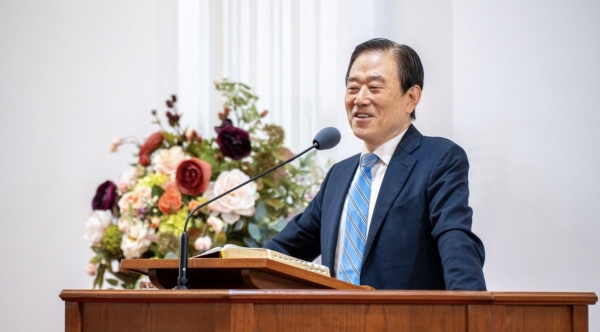
In his sermon on Romans 8:28–39, Pastor David Jang, founder of Olivet University in the United States, examines this question through one of the Apostle Paul's most profound declarations of Christian hope. His message directs believers beyond the uncertainty of their circumstances toward the unchanging love of God revealed in Jesus Christ.
The assurance Paul describes is neither superficial optimism nor an escape from life's painful realities. It is a confidence grounded in God's eternal purpose, Christ's redemptive work, and the promise that nothing in all creation can separate believers from His love.
Romans 8:28 — Does Everything Really Work Together for Good?
In Romans 8:28, Paul declares that all things work together for good for those who love God, those who are called according to His purpose.
Few verses have offered greater comfort to Christians facing uncertainty. Yet few have also raised such difficult questions.
Can the consequences of an irreversible mistake truly work toward good? What about the death of a loved one, the collapse of a cherished dream, or suffering that seems to have no explanation?
Does faith require us to call these experiences good simply because they occur within God's providence?
Paul's words do not demand such a conclusion.
The promise that God works all things together for good does not mean that all things are good in themselves.
There is a crucial distinction between the moral character of an event and God's sovereign ability to work through it.
Pain remains painful. Evil remains evil. Loss does not cease to be loss simply because God is at work.
Yet the circumstances visible to us at any given moment cannot reveal the full meaning of our lives. An apparent success may eventually leave us spiritually empty, while an experience of failure may expose a deeper need for repentance, wisdom, or renewed direction.
The central emphasis of Pastor David Jang's message is not that believers possess the ability to predict a happy ending. Rather, it is that God's purposes extend beyond the limits of human understanding.
Our perspective is partial. God's faithfulness is not.
But what exactly is the "good" toward which God is working?
The answer appears in the very next verse.
Romans 8:29 reveals that those whom God foreknew He also predestined to be conformed to the image of His Son.
This connection is essential. The good promised in Romans 8:28 cannot be reduced to financial prosperity, personal achievement, restored comfort, or the fulfillment of every human desire.
Its deepest meaning is inseparable from God's saving purpose: that His people should become like Jesus Christ.
God's ultimate goal is not merely to improve our circumstances but to transform us through His grace.
Paul's own life illustrates this truth.
Before encountering the risen Christ on the road to Damascus, Paul had persecuted the church. His religious zeal had led him to oppose the very gospel he would later proclaim.
His persecution was not good. It was a grievous wrong.
Yet God's grace redirected his life so completely that the knowledge, determination, and passion he once employed against Christians became instruments in his mission to proclaim Christ.
The past was not rewritten as righteousness. Rather, a sinner was transformed and given a new direction.
For those who remain imprisoned by past failures, Paul's testimony offers a profound encouragement.
We cannot undo yesterday. But through God's grace, yesterday's failures need not determine the direction of tomorrow.
Foreknowledge and Predestination — God's Purpose Is to Make Us Like Christ
Romans 8:29–30 introduces a sequence of theological concepts that have shaped centuries of Christian reflection: foreknowledge, predestination, calling, justification, and glorification.
These verses have generated extensive discussion concerning divine sovereignty, human responsibility, and the mystery of salvation.
Yet Paul's immediate purpose is not to invite anxious speculation about the hidden decrees of God. He is strengthening the confidence of believers by directing their attention to the certainty of God's saving purpose.
Foreknowledge speaks of God's prior knowledge of those who belong to Him. Predestination, in this passage, identifies the purpose for which they have been appointed: conformity to the image of Christ.
Whatever distinctions Christian traditions may draw in explaining these doctrines, Paul's emphasis is unmistakable. Salvation is grounded in God's gracious initiative, not in the independent merit or achievement of human beings.
Pastor David Jang draws attention to the progression of Paul's argument.
Those whom God foreknew, He predestined. Those whom He predestined, He called. Those whom He called, He justified. And those whom He justified, He also glorified.
This sequence reveals the unity of God's saving work.
The God who initiates salvation is faithful to bring His purpose to completion.
Particularly striking is Paul's use of the past tense when speaking of glorification.
The final glorification of believers remains a future hope, yet Paul speaks of it as though it were already accomplished. This remarkable expression underscores the certainty of God's promise.
The future fulfillment of salvation is so secure in God's purpose that Paul can describe it with the confidence of a completed reality.
Such assurance liberates believers from the exhausting attempt to measure their standing before God solely by the fluctuations of their emotions or the apparent success of their spiritual efforts.
Nevertheless, the doctrine of predestination loses its proper focus when it becomes merely a source of personal security.
Paul explains that Christ is to be the firstborn among many brothers and sisters.
God's saving purpose is therefore not limited to securing an individual's place in heaven. It involves bringing believers into the family of God and forming within them the character of His Son.
Salvation calls us into a life increasingly shaped by Christ's love, obedience, holiness, mercy, and humility.
Grace is not only the foundation of our future hope. It is also the power that transforms how we live in the present.
This transformation, however, is not instantaneous.
Old habits may resurface. We may speak carelessly, wound others, or discover that attitudes we thought we had overcome still remain within us.
Such struggles are part of the painful reality of sanctification.
Yet the experience of spiritual weakness does not, by itself, prove that God has abandoned His people.
The appropriate response is neither despair nor indifference, but repentance and renewed obedience.
We do not repent in order to purchase salvation. We repent because the grace that saves us also calls us into a transformed life.
Our assurance of salvation rests not upon the perfection of our performance, but upon the faithfulness of the God who saves.
The Cross and Christ's Intercession — An Answer Greater Than Condemnation
In Romans 8:31, Paul asks a question that stands at the heart of Christian confidence:
"If God is for us, who can be against us?"
This is not a promise that Christians will encounter no enemies, experience no injustice, or suffer no hardship.
Paul knew too much about persecution to make such a claim.
Instead, his question points to a reality greater than every opposing force: God's decisive commitment to the salvation of His people.
The foundation of that confidence appears in Romans 8:32.
God did not spare His own Son but gave Him up for us all.
Here, Paul directs the reader away from the uncertainty of present circumstances and toward the historical reality of the cross.
God's love does not begin when life becomes comfortable. It has already been revealed in the sacrifice of Jesus Christ.
Pastor David Jang connects this passage with the account of Abraham and Isaac in Genesis 22.
Abraham's willingness to offer his beloved son has long been understood within Christian interpretation as a foreshadowing of the greater sacrifice fulfilled in Christ.
Yet there is a profound distinction between the two events.
Isaac was spared. Jesus Christ was given for our redemption.
The God who provided a substitute for Isaac ultimately revealed the fullness of His saving love by giving His own Son.
Paul's reasoning follows naturally.
If God has already given His Son for our salvation, we can trust Him to provide everything necessary to accomplish the saving purpose for which Christ was given.
This promise, however, must not be confused with a guarantee of material wealth, effortless success, or freedom from every earthly difficulty.
The context is salvation. Paul's assurance concerns God's unfailing commitment to His redemptive purpose.
The argument then moves from divine generosity to divine justification.
Paul asks who can bring a charge against God's chosen people and who has the authority to condemn them.
These questions speak directly to the human experience of guilt, accusation, and shame.
A troubled conscience can become an unforgiving judge. The criticism of others can continue to echo within us long after the moment has passed.
Sometimes the harshest verdict comes from our own hearts.
Yet Paul reminds believers that the final judgment concerning their justification does not belong to public opinion, personal regret, or the accusations of an anxious conscience.
God is the one who justifies.
And Jesus Christ, who died and rose again, now sits at the right hand of God and intercedes for His people.
This truth becomes even more powerful when read alongside the earlier verses of Romans 8.
In verses 26–27, Paul describes the Holy Spirit helping believers in their weakness and interceding according to the will of God.
In verse 34, he reveals the continuing intercession of the risen Christ.
Together, these passages present a remarkable picture of divine grace.
Even when believers struggle to pray, the Spirit helps them in their weakness. Even when they face the burden of accusation, Christ intercedes on their behalf.
Christian assurance is sustained not merely by the strength of our grip on God, but by the grace of the God who holds us.
This assurance does not eliminate the need for repentance. It makes genuine repentance possible.
Acknowledging sin can be frightening because it requires us to relinquish our excuses and confront the truth about ourselves.
But when we know that our hope rests in Christ rather than in self-justification, we become free to confess our wrongs honestly.
We no longer need to hide behind denial or defend every failure.
Grace gives us the courage to turn back to God.
Nothing Can Separate Us from the Love of Christ
Romans 8:35 brings Paul's argument to an intensely personal level.
He names the suffering that believers may experience: tribulation, distress, persecution, famine, nakedness, danger, and the sword.
These are not abstract theological possibilities.
They describe the realities faced by the early church, and many of them reflect Paul's own experience as a servant of the gospel.
For this reason, his declaration in verse 37 that believers are "more than conquerors" must not be interpreted as a denial of suffering.
Paul does not promise that the faithful will never experience hunger, persecution, danger, or death.
Indeed, he recalls the language of Psalm 44, where God's people suffer despite their covenant relationship with Him.
Christian victory, therefore, cannot be defined simply as the absence of hardship.
It means that hardship itself cannot defeat God's ultimate saving purpose.
The victory belongs to believers through the One who loves them.
This distinction is essential.
A faith that depends entirely upon visible success will inevitably falter when circumstances turn against it. But a faith grounded in the crucified and risen Christ possesses a foundation that suffering cannot destroy.
Paul then reaches the magnificent conclusion of Romans 8:38–39.
Neither death nor life, neither angels nor rulers, neither present circumstances nor future uncertainties, neither height nor depth, nor anything else in all creation can separate believers from the love of God in Christ Jesus our Lord.
The scope of this declaration is breathtaking.
Paul moves through the extremes of human existence, the forces of the spiritual realm, the uncertainties of time, and the vast dimensions of creation.
His conclusion is that no created power can overturn the love God has revealed in His Son.
This is not confidence built upon the assumption that life will always become easier.
It is confidence grounded in the cross and resurrection.
When the future appears uncertain, believers do not have to interpret their fear as evidence that God has withdrawn His love.
When prayers remain unanswered, they need not conclude that suffering has become God's final verdict upon their lives.
And when circumstances resist explanation, they can continue to trust the character of the One whose love has already been revealed in Jesus Christ.
Pastor David Jang relates this assurance to the doctrine of the perseverance of the saints.
At its heart, this doctrine affirms that God's sustaining grace preserves His people and brings His saving work to completion.
The ultimate security of salvation rests in divine faithfulness rather than human self-sufficiency.
But this conviction must never be turned into an excuse for spiritual complacency.
The God who preserves His people is also the God who calls them to be conformed to the image of Christ.
Assurance and obedience are not competing truths.
The more deeply believers understand the grace that sustains them, the more seriously they should respond to the calling that grace places upon their lives.
To trust that God will hold us to the end is to recognize that the way we live today truly matters.
The Christian response to suffering, then, is not to suppress grief or insist that everything is fine.
Pain must be acknowledged honestly. Loss may be mourned. Questions may remain unanswered.
But suffering need not be accepted as the final definition of our relationship with God.
When we have sinned, we can repent.
When others reveal their weakness, we can resist the impulse to condemn them.
When circumstances remain unresolved, we can still choose patience, compassion, integrity, and obedience in the responsibilities entrusted to us.
Faith is not merely a declaration about what we believe will happen in eternity.
It is a living trust that gradually reshapes the choices, relationships, and attitudes of ordinary life.
This is how the assurance of God's unbreakable love becomes visible in the daily practice of discipleship.
The Love That Remains When the Burden Has Not Disappeared
We return to the pilgrim in The Pilgrim's Progress.
At the cross, the burden that had weighed upon Christian's shoulders finally falls away.
Yet the remainder of his journey is not free from danger, temptation, or hardship.
The removal of his burden does not mean that the road ahead will be easy.
It means that he can now continue his journey with a new foundation for hope.
The same distinction illuminates Paul's message in Romans 8.
Our lives may still contain unanswered prayers, painful memories, unresolved conflicts, and fears about what lies ahead.
Some losses cannot be reversed. Some wounds take years to heal. Some questions may remain unanswered throughout our earthly lives.
But none of these realities determines the depth of God's love.
That love is not measured by the ease of our circumstances or the absence of suffering.
Its decisive revelation is found in Jesus Christ, whom God gave for our salvation.
Romans 8 does not invite believers to escape reality through religious optimism. It calls them to face reality with a hope stronger than despair.
The God who works all things according to His saving purpose is the same God who justifies, sustains, and promises to complete the work He has begun.
And the Christ who died and rose again continues to intercede for those who belong to Him.
This is why the final word over the Christian life does not belong to failure, condemnation, suffering, or death.
It belongs to the love of God in Christ Jesus.
Am I still allowing the failures of yesterday and the fears of tomorrow to pronounce the final verdict over my life, or will I trust the God who gave His own Son for me and begin today, through even the smallest act of obedience, to become more like Christ?
Dr. David Jang has proclaimed the gospel in various regions of the world through field missions and digital media ministry, and as the fruit of that ministry, many people devoted to the Great Commission have been raised up. Based on this missionary vision, Olivet first began as a small church school for missionary training. Later, in order to provide more systematic theological education and cultivate missionary leaders, Olivet Theological College and Seminary was established in Los Angeles and Seoul in 2000.
As the school grew, Dr. Jang officially founded Olivet University in San Francisco in 2004. In the diverse and dynamic environment of San Francisco, Olivet expanded its educational fields beyond theology to include music, journalism, art and design, and technology. The university also strengthened its educational capacity by recruiting faculty members, including Dr. William Wagner, and in 2005 moved to the former UC Berkeley Downtown Extension campus, further solidifying its foundation as a university.
In 2006, Dr. Jang transferred the presidency to Dr. David James Randolph in order to focus more fully on missionary work, while continuing to lead global missions as International President. Olivet University later received institutional accreditation in 2009, added a language education college and a business college, and continued to grow as a Christian educational institution for world missions by expanding its degree programs and international partnerships.